How to turn irregular revenue into regular income
As a freelancer, you are now the custodian of tax payments and your own social security contributions. Here's how to set up a predictable personal cash flow, even if your business income feels all over the place.

As an employee, your monthly paycheck is yours to keep, maybe with a small margin of error that gets rectified once a year through your tax declaration.
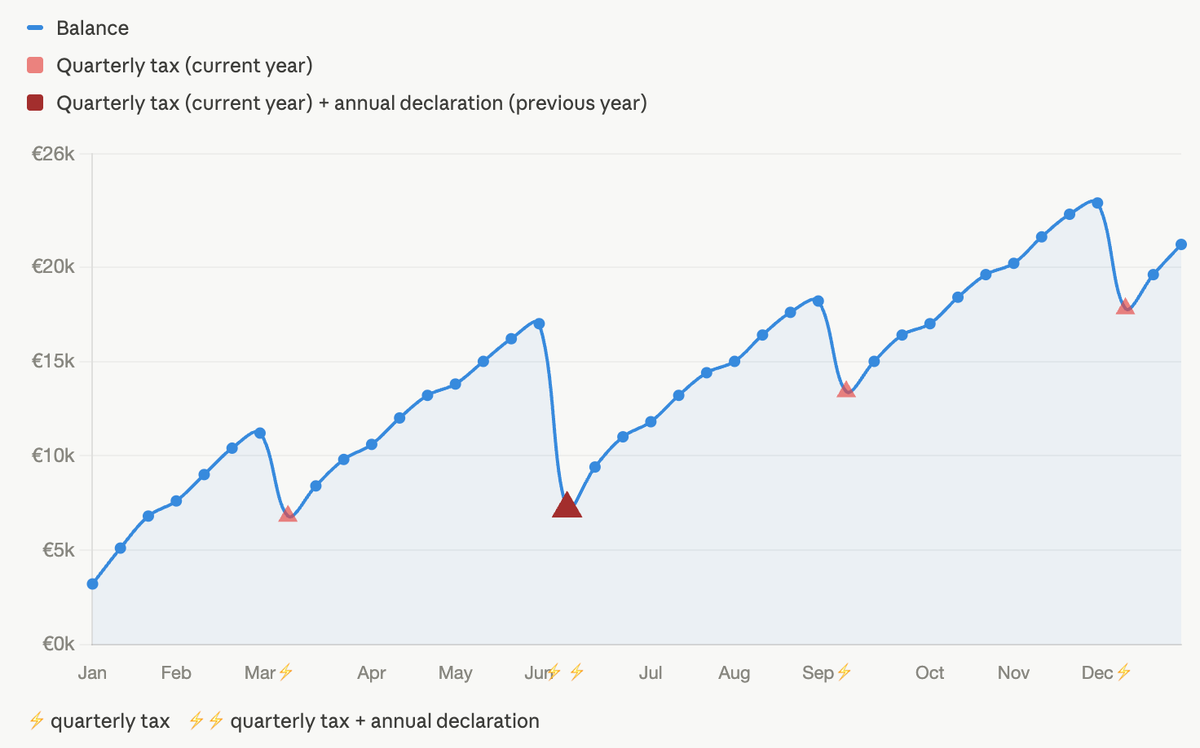
As a freelancer, that story looks very different. Depending on your specific setup, roughly half of the incoming money is actually yours. You are now the custodian of tax payments (both your taxes and VAT, if applicable) and your own Social Security contributions. And while tax payments in Spain are due every three months (for autónomas), above a certain threshold, you will most likely have to pay additional taxes at tax declaration time.
Add that to the fluctuating income of your freelance existence, and you’ve created the perfect roller coaster of emotions - closely following the ups and downs of your bank account.
The good news is that as soon as you start treating your freelance activity as your legitimate business, you can circumvent that roller coaster. This practice also doubles as your training ground for the future, especially if your goal is to grow and scale.
I’ll assume that you already created a dedicated bank account for your freelance activity. It makes accounting easier. It ensures you don’t miss out on any deductible expenses and is the easiest way to justify your activity should Hacienda ever ask for more details.
Your brain loves predictability: give yourself a salary
Now that your professional activity has its own financial home, it’s time to give yourself a salary, preferably one that stays roughly the same every month. Have a look at your cash flow from the last year or so, and calculate how much you can reasonably use yourself without dipping below the revenue that you are generating.
Let’s look at an example. Mia is a web designer from Toulouse who moved to Girona five years ago. Last year, she generated 70,000 EUR in revenue. Since most of her clients don’t live in Spain, her invoices do not carry VAT, and no IRPF retention was collected on her behalf. She knows that she has to account for that in her yearly tax declaration. She knows that roughly 50% of her revenue is going to go to taxes, Social Security, tooling, and other expenses. If we look at the distribution of her revenue, she invoices significantly more from February to May and from October to December.
So this is what she decided to do:
All her invoices are going to be paid into her freelancer account.
All tax payments, Social Security payments, and all business expenses will go through that freelancer account.
And she’s going to set up a monthly bank transfer to her personal account of 2,500 EUR, independently of how many payments she received that specific month. This is her self-assigned net salary.
Over a 12-month period, that means she’ll be charging herself 30,000 EUR, leaving more than half of her revenue in the freelancer account - as a buffer she designed intentionally. That means she can now take December off if she wants to, or get herself a nice bonus when the yearly tax declaration requires her to pay less than what’s left in the account.
It’s time to focus on the big picture
But most importantly, having a fixed amount every month that she can count on reduces the worry about whether she’ll be able to pay her bills this specific month. Day to day, she focuses on her personal account, which predictably fills up again. Once a month, she reviews her freelancer account to make sure she is on track with her own revenue goals. And she has completely stopped worrying about tax payments - because those are covered and then some.
This is exactly the kind of thing we set up with our clients — the salary structure, the tax buffers, the quarterly rhythm. Book a discovery call to see if we're the right fit.