Pension Plans for Freelancers (tax edition)
Spain has a public pension system, and part of your quota de autónomos contributes to this system. Here's how to figure out what that means for you (and what to do about it).


Spain has a public pension system, and part of your quota de autónomos contributes to this system. If you want to find out your current pension rights, the Seguridad Social has this neat simulator that gives you a rough estimate of how much you are going to get once you have amassed the 25 mandatory years of contribution (which you may or may not reach, depending on when you came here).
Check it out for yourself, and once you’ve recovered from the reality shock, let’s have a look at what else is out there - and how to take control of your financial future.
This is what my result looks like:
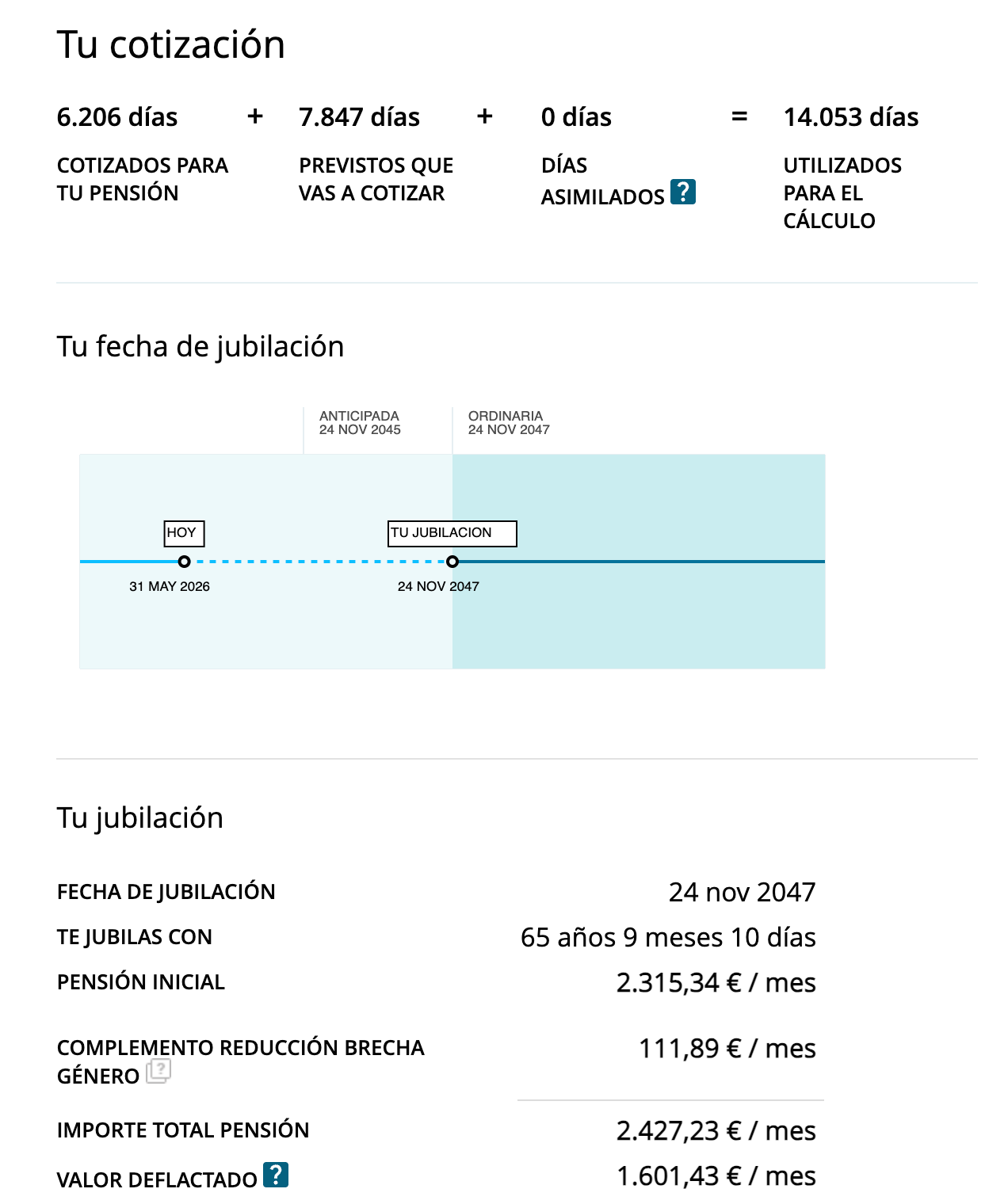
At the top, you can see the number of days you’ve already amassed, how many days you still have to work to be eligible for a pension, plus any additional days that might be added due to childbirth or other circumstances.
You get a lovely graph to show how far along you are, and then, the interesting numbers: if you continue to contribute at the same level you are contributing today, the “importe total pensión” is your monthly pension payment in today’s money.
The valor deflactado takes into account an estimated 2% inflation per year, meaning that the 2,427,23 EUR / month are equivalent to 1,601,43 EUR in today’s money.
Seriously, run your own simulation and check your own numbers!
Enter: Tax-incentivised private pension funds
To complement the public pension, the Spanish state has created different incentives to get people to start saving for their own retirement on an individual basis. Sometimes that means you can add the yearly saving to be deducted from your tax base. Sometimes it means the capital gains of your savings are tax exempt.
As a freelancer in Spain, you can reduce your tax base by up to 5750 EUR, saving you between 1600 and 2500 per year (depending on your income)
The Plan de Pensiones is available for both employees and freelancers. You can contribute up to 1,500 EUR per year, and those 1,500 are deductible in your yearly tax declaration. You will be paying taxes on the payout later in life - but at that time, you’ll very likely be in a lower tax bracket.
Most established banks offer this Plan de Pensiones, since it’s a product they can offer to all their (individual) clients.
The same tax-logic applies to the Plan de Pensiones de Empleo Simplificado (PPES), which is a similar product specifically for autónomas and autónomos who do not have access to employer-based plans. As a freelancer you can save an additional 4,250 EUR per year, again, deductible in your tax declaration. And yes, this also applies to autónomos societarios (if you have an SL).
Since the PPES has only been around since 2023, not every bank offers the option right now. Check with your bank, but if they don’t offer it, don’t stop there. You don’t need to change banks just to get access to a PPES. They are available as stand-alone products, and it’s worth investing those extra 20 min of research to find one that works for you.
Important: pension funds are illiquid. That means, you are supposed to keep the money in there until you retire. You can stop adding additional money at any point, but if you decide to take money out, that money gets added to your current year’s tax base, potentially wiping out the tax savings you built up.
You can move your pension funds between entities. If you decide to change banks, you can instruct your new bank to take over your pension plan (if they offer an equivalent product). This would not impact your tax declaration in any way and you simply continue saving (or keeping it as is) at the new bank.
An additional option to pay less taxes on your pension
If you want to save more specifically for retirement purposes (that is: long term, because you know you want to retire in Spain), there are some solutions that can reduce your tax base at payout. The PIAS (Plan Individual de Ahorro Sistemático) is one example, where the capital gain can be fully tax-exempt, as long as you saved for more than 5 years and take the money out as a regular income (not a lump sum) You do pay a small income tax on each payment, but the percentage gets smaller, the older you are. Full details are here, if you are curious.
With a PIAS you can save up to 8,000 EUR a year (to a maximum of 240,000 EUR).
Finding the balance between now and later
Even if you don’t plan to retire, you should have a date in mind after which work becomes optional. By all means, continue if you love it. But just like a F*ck You fund allows you to walk away from clients (or relationships) that no longer serve you, having a retirement plan in place allows you to make a decision - instead of being backed into a corner.
Obviously, the best time to start saving was 10 or 20 years ago. But the second best time is today. So get that Plan de Pensiones in place, and let’s have a conversation about where you are now.